
What happens to support, benefits, and custody when your child has a disability, and what to settle before you sign anything.

Divorce is hard on any family. When a child has a disability, or a parent does, the divorce has to carry more than the usual questions, because support, custody, care, and public benefits all move at the same time, and a decision made for one of them can quietly undo another. This page lays out the pieces in plain language: what can continue past 18, what needs protecting before anything is signed, and the rights disabled parents hold in the process. It is general information, not legal advice, and it is written to help you walk into a lawyer’s office or a mediator’s room already knowing which questions matter.
Divorce with a disabled child
Support does not always end at 18
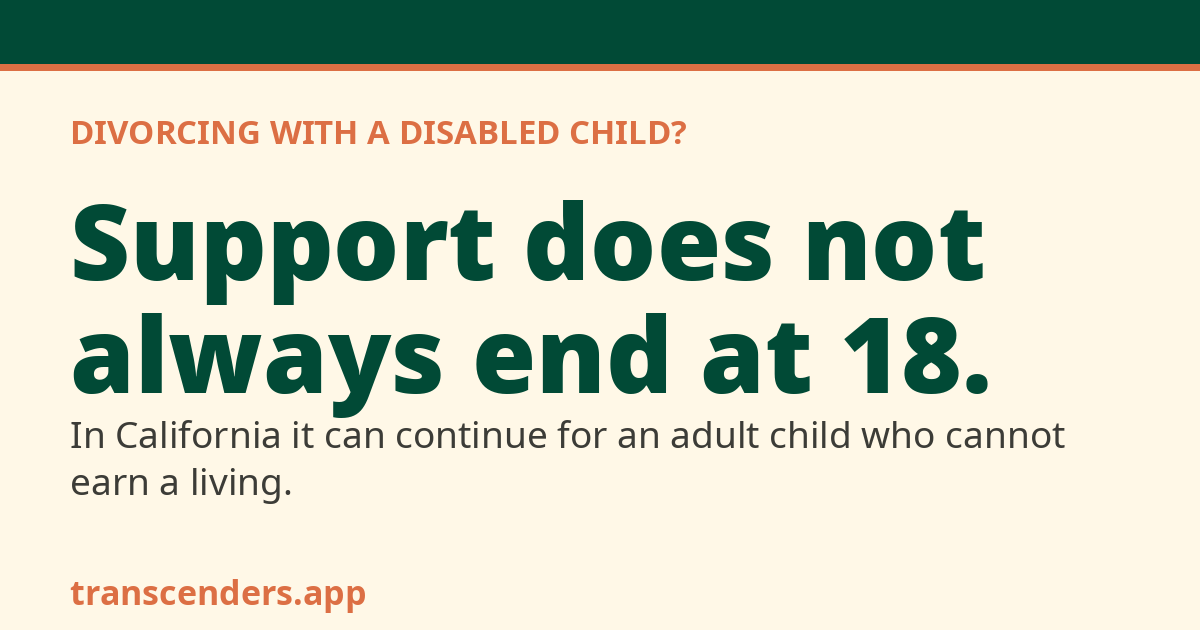
Most parents are told child support ends at adulthood, full stop. For a child who cannot earn a living because of a disability, that is not always the end of the story. In California, a parent’s duty to support can continue for an adult child who is incapacitated and without sufficient means, and other states have their own versions of the same idea. Whether support continues, and how it is structured, depends on the child’s actual capacity to earn, which is a functional question, not a diagnosis question. If your child is approaching adulthood, raise this early, while the orders are being written, not after they are final.
Protect the benefits before anything is signed
Support, settlements, and savings interact with SSI and Medicaid in ways that surprise almost everyone. Money paid or held the wrong way can reduce or interrupt benefits your child depends on, and the fix after the fact is slower and more expensive than the planning before it. Before a divorce is final, a benefits-aware review should cover how support will be paid, whether a special needs trust belongs in the settlement, and how college savings, ABLE accounts, and inheritances from either side will be handled. One meeting with an attorney who knows special needs planning can protect years of benefits.
More on the tools: Special Needs Trusts and ABLE Accounts
Custody and care run on the child’s real life
Custody schedules for a child with a disability have to be built around care, not just calendars: medications, therapies, equipment, school meetings, and the routines that keep this particular child steady. Two households are now part of the child’s support system, and the child should never become the messenger between them. Records, meeting notes, and care instructions need to live in both homes, and both parents need the same picture of the child’s needs. A plan that ignores the care reality will be back in front of a judge. A plan built on it gives the child consistency in the middle of a change they did not choose.
Get the care costs in writing
Therapy copays, specialized childcare, transportation to appointments, respite, equipment, tutoring: disability adds real line items to a family’s budget, and divorce paperwork that pretends otherwise leaves one parent carrying costs the orders never counted. List them, cost them, and put them in the conversation explicitly. Judges and mediators can only divide what has been named.

Disabled parents have rights too
A disability is not evidence of unfitness
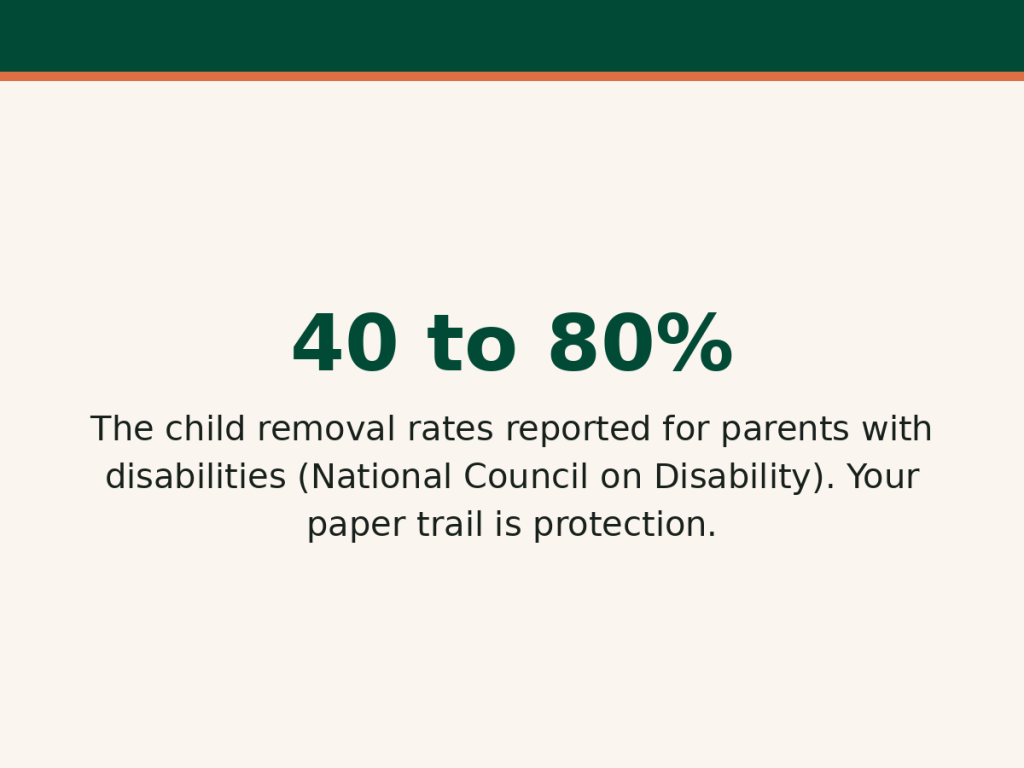
Parents with disabilities face custody questions that other parents never hear, sometimes from the other parent and sometimes from the system itself. The standard in a custody case is the child’s best interest and the parent’s actual ability to care for the child, with support, equipment, and services counted as part of real parenting, the way they are for every family. A diagnosis, a label, or the mere fact of receiving disability benefits is not proof that a parent cannot parent. If your fitness is being challenged on the basis of disability rather than on evidence about your child’s care, that distinction matters, and it is worth having an advocate who will insist on it.
Ask for an evaluation that measures parenting, not labels
When evaluations enter a custody case, the quality of the evaluation decides a great deal. An evaluator should look at what you do as a parent: the care you provide, the supports you have built, the child’s bond and wellbeing in your home. Evaluations that stop at a diagnosis or test scores that were never designed to measure parenting can mislead a court. You can ask who the evaluator is, what they are qualified to assess, and whether their methods account for disability fairly. Those are reasonable questions, and asking them is part of protecting your family.
Accommodations apply to the process, too
Courtrooms, mediation, and co-parenting classes are processes you have a right to access. If you need an accommodation to participate fully, interpreters, accessible formats, extra processing time, a support person where the rules allow, ask for it, in writing, as early as you can. Participation is not a favor. It is how the record gets made, and the record is what decisions rest on.
Get the free guide
The Divorce and Disability Parent Guide pulls this page into a printable document: the questions to ask before anything is signed, the care cost list to build, and the benefit protection checks to run, in one place you can hand to a lawyer, a mediator, or the other parent.
Email me this worksheet instead
Pass it on
Things Nobody Told You, live.
The webinar series is coming: live sessions with Tera Lisicky, M.Ed., each one ending with your questions. First up: Turning 18 With a Disability, the master checklist walkthrough. Then SSI at 18 and the DAC benefit. Then From Helpless Child to Chapter 35. Then AI as a College Accommodation. Dates are being scheduled now, and this list hears them first.
Join the webinar list:
Get divorce and disability updates by email.
Not sure which of this applies to your family?
Divorce touches the same systems the Family Navigator maps: benefits, school, services, and the paperwork that holds them together. Start there for the pieces beyond the divorce itself, and bring this page’s questions to the professionals handling your case.